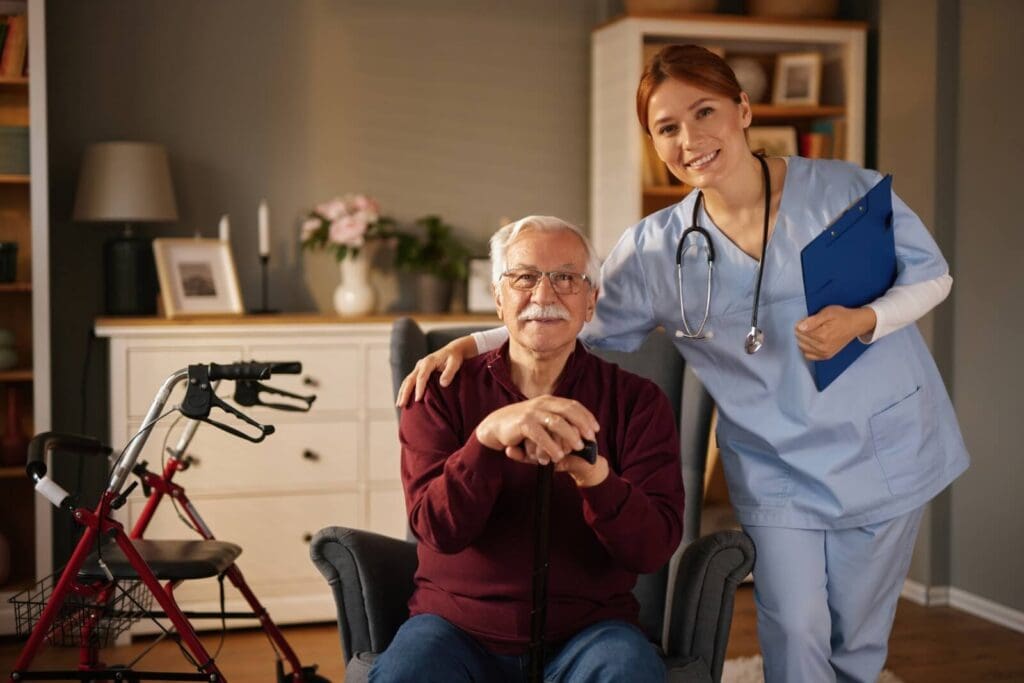
Senior care communities have a wide range of services, amenities, and features that help senior residents maintain their health and wellness. Skilled nursing services are typically not provided in standard care offerings of senior care communities, unless the community is a skilled nursing facility, nursing home, CCRC, or another level of care that offers these services. Some senior care communities that do not offer skilled nursing services may allow residents to bring in home health care services when needed to meet their skilled nursing needs.
Here, we’ll go over what it means to bring these services into senior living to supplement the services you receive in the community. We’ll also explain the reasons seniors may need the services and the many benefits for seniors and their loved ones.
Home health care definition
In this context, when we refer to home health care, we are using the term as defined under Medicare coverage rules. Under Medicare coverage, it is a short-term or intermittent service that brings skilled nursing care and related services directly to the home.
Services may include:
- Skilled nursing care, such as wound care, injections, complex condition management, and more.
- Occupational, physical, and speech therapy. These all help with strengthening and rehabilitation.
- Education. Experts can help seniors and family members understand how to best manage their health.
- Practical assistance with personal care tasks like bathing, using the toilet, and dressing.
- Medical social services, which can help with resources, support, and guidance.
Under Medicare, the last three services are available only if skilled nursing care or physical, occupational, or speech therapy has been ordered.
You can also pay for similar care independently by hiring professionals privately or through an agency. This option can be expensive but is more flexible than Medicare’s coverage rules.
Medicare coverage
Medicare has multiple criteria for eligibility. Recipients must:
- Be homebound by Medicare’s definition.
- Have a physician-certified medical need.
- Be enrolled in Medicare.
- Require part-time or intermittent care.
Where is home?
The term “home” in home health care implies that residents are in a house they own or rent.
However, home health care is often used in assisted living to supplement the services the facility offers. The Medicare Benefit Policy Manual also extends the definition to wherever the resident makes their home, as long as this isn’t a hospital, skilled nursing facility, or nursing home.
That is to say, the environments that don’t provide skilled nursing care themselves can all be considered home in the context of home health care.
Benefits of home health care for seniors in senior living communities
Supports aging in place
Home health care has multiple benefits for individuals who are aging in place, including:
- Improved disease management skills.
- Better strength and mobility.
- A reduced need to move to a senior care community.
- Significant health improvements.
Provides care in a familiar environment
Remaining at home:
- Can reduce feelings of stress, anxiety, and overwhelm.
- Makes it easier to maintain familiar routines.
- Reduces the need to travel.
- Can decrease fear and disorientation for people with dementia.
Reduces emergency transfers
The availability of home health care reduces the need for emergency hospital or skilled nursing facility visits. This, in turn, means less stress and a reduced risk of hospital-related infections.
Fills care gaps
Many communities legally cannot provide skilled medical care, so home health care can be essential for ensuring resident needs are met.
This is particularly true for assisted living, as there are clear legal guidelines about the level of care that can be provided (although these guidelines vary by state). Policies for Michigan and the District of Columbia even specifically mention that assisted living residents have the right to access home health care.
Independent living communities often encourage home health care as well, as residents are expected to take care of their own needs.
Whether one can access home health care in memory care is a bit different, as memory care can be located in various settings, including assisted living, nursing homes, and dedicated memory care facilities. As mentioned above, if the facility provides skilled nursing care, Medicare will not cover home health care. However, if the service is provided in an assisted living wing, it may be an option.
Can improve care coordination
Home health care can also help with care coordination, as staff have experience communicating with health care professionals across many contexts.
Benefits of home health care for families and caregivers
Reduces caregiver burden
Regardless of where a senior lives, family members often provide practical and emotional support. Having home health care on hand allows family members to step back and get some much-needed rest.
Reduces stress
Home health care is beneficial to non-caregiver family members, too. Notably, knowing that extra professionals are there to support your loved one often helps reduce stress and improve confidence.
If nothing else, it’s simply reassuring to know that more people are working to make sure the senior is healthy and well cared for.
Can help with decision-making
Home health care is also an excellent source of knowledge. Team members can help you understand when the current environment is sufficient and when transferring to a higher care environment might be needed.
When home health care is commonly used
Home health care is largely a short-term service, making it most relevant when intervention can lead to notable health improvement or stabilization.
Common situations include:
- Recovery after surgery or hospitalization. The senior’s health may have improved enough for discharge, but they may still have nursing or rehabilitation needs.
- Wound management, for example with diabetic foot ulcers, post-surgical wounds, or pressure sores.
- Chronic condition flare-ups (like diabetes or COPD). Here, this care may help stabilize the condition and teach self-management strategies.
- Medication administration. This may include IV medications, injectable medications, and medications that require monitoring.
- Rehabilitation after an illness or fall. Even if a hospital visit isn’t required, the senior may still need help to strengthen and recover.
Arranging home health care in senior living
There are two main aspects of arranging home health care for senior living:
- Setting up the care itself.
- Organizing with the senior living community.
Setting up home health care
Home health care begins with a doctor’s referral. The doctor must certify that this care is medically necessary and that the senior is homebound (as defined by Medicare).
Such a referral often happens as part of a hospital discharge process or with your own doctor. Some communities may also have systems to make this process easier.
Once the medical order is in place, you can choose a Medicare-certified home health agency, and a plan for your care will be developed.
Organizing with the community
You’ll need to first verify that the community allows individuals to hire third-party home health care agencies. You must also ensure the agency you choose meets the community’s guidelines and is willing to coordinate its timing as required.
It’s often best to begin by talking to community staff. They can inform you of any specific procedures and provide you with all the necessary information.
For example, some agencies may require:
- Proof that the agency is licensed.
- Verification of the specific tasks performed to ensure the facility isn’t breaking state laws.
- Background checks.
There may also be restrictions on some types of services, like:
- Administration of controlled substances.
- Heavy wound care.
- The use of some types of equipment, like IV lines or tube feeding.
Such restrictions will often be based on state law but may also relate to the facility’s staffing and policies.
The type of community makes a difference, too. In particular:
- Independent living will often have relatively few requirements and restrictions, as this type of community is lightly regulated and it’s common for residents to hire services as needed.
- Assisted living has more rules, as there are highly specific regulations in state law. Some of these affect the care that assisted living staff can provide, while others may affect what can be provided in the facility overall.
- Memory care can be more restrictive again, as it’s a secure environment with vulnerable residents.
Home health care provides valuable support for seniors in senior living settings by bringing skilled services directly to where they live. It fills care gaps that many communities cannot address, helps prevent unnecessary transfers, and supports recovery and stability. Families also benefit from reduced stress and greater confidence in their loved one’s care. By allowing seniors to receive needed medical support without leaving their familiar environment, home health care helps maintain safety, independence, and quality of life.
Senior care facility rules and requirements vary based on company-specific policies and state-level regulations. The content above represents common guidelines but may differ from a particular facility’s policies or requirements. To learn the regulations that apply in your state, contact your local Oasis Senior Advisor.